
The Perfectionism Trap: How Perfectionism and Anxiety Keep Each Other Going
"If I can just get everything right, maybe I'll finally stop feeling so anxious."
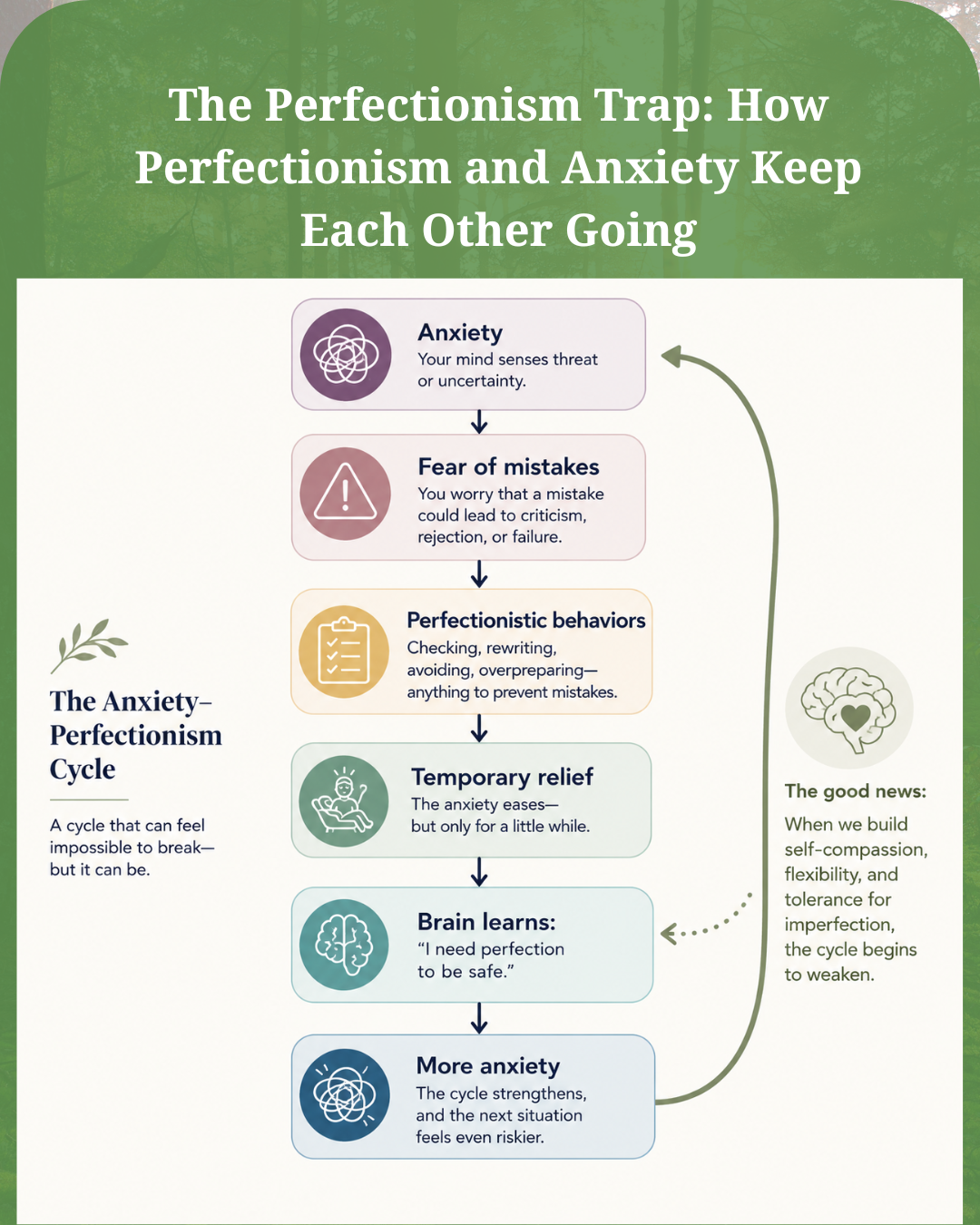
Many people who struggle with anxiety believe that perfectionism is helping them. They double-check emails, spend hours preparing for meetings, avoid trying new things until they feel "ready," or hold themselves to impossibly high standards because they think it prevents mistakes and keeps life under control.
At first, it can seem like this approach works. But over time, perfectionism often becomes one of the biggest drivers of anxiety. As therapists, we often see these two experiences feeding into one another in a cycle that becomes difficult to break. Understanding how that cycle works is the first step toward changing it.
What Is Perfectionism?
Perfectionism is often misunderstood. It isn't simply caring about doing a good job or having high standards. Healthy striving can motivate us to learn, grow, and take pride in our work.
Perfectionism is different. It involves believing that mistakes are unacceptable, that your worth depends on your performance, or that anything less than perfect is failure.
Some common signs include:
Spending excessive time trying to get things "just right."
Feeling intense fear of making mistakes.
Constantly seeking reassurance that you did well.
Procrastinating because you're afraid your work won't be good enough.
Avoiding challenges unless you're confident you'll succeed.
Being highly critical of yourself, even after doing well.
People with perfectionistic tendencies often look successful from the outside, but internally they may feel exhausted, anxious, or like they're never quite measuring up.
Why Anxiety and Perfectionism Go Hand in Hand
Anxiety is our brain's way of trying to protect us from danger. The problem is that an anxious brain often starts treating ordinary situations as if they're high stakes.
A presentation at work becomes a test of your worth. A typo in an email feels like proof you're incompetent. A difficult conversation feels like it could permanently damage a relationship. Perfectionism develops as an attempt to reduce that anxiety.
Your brain begins telling you: "If I prepare enough, nothing bad will happen."
"If I never make mistakes, people won't judge me."
"If I can control everything, I'll feel safe."
For a short time, these behaviors may reduce anxiety. But because they seem to "work," your brain learns that perfectionistic behavior is necessary for safety.This is where the cycle begins.
The Anxiety-Perfectionism Cycle
Imagine you need to send an important email. You begin feeling anxious. Instead of sending it, you spend an hour rewriting every sentence. Eventually, you send it and feel relieved. Your brain notices that relief and concludes: "Good thing we checked it twelve times. That's what kept us safe."
The next time, the anxiety returns even stronger because your brain now expects the same level of perfection before it feels safe again. Over time, the standards become harder and harder to meet. Instead of reducing anxiety, perfectionism slowly teaches your brain that ordinary situations are dangerous unless you perform perfectly.
When Perfectionism Leads to Avoidance
One of the most surprising effects of perfectionism is that it often causes people to avoid the very things they care about.People may:Delay applying for jobs until their resume is "perfect."Avoid dating because they don't feel confident enough.Put off creative projects indefinitely.Decline leadership opportunities.Never start hobbies because they fear being bad at them.From the outside, it may look like procrastination.Inside, it often feels like protection.Unfortunately, avoidance prevents us from learning an important truth:We can make mistakes, survive them, and continue growing.
The Cost of Constant Self-Criticism
Many perfectionists believe being hard on themselves is what keeps them motivated. Research suggests the opposite. Persistent self-criticism is associated with greater anxiety, depression, burnout, and lower overall well-being.
Instead of improving performance, harsh self-judgment often increases fear, making it harder to think clearly, solve problems, and recover from setbacks (Egan, Wade, & Shafran, 2011). Imagine coaching a child by criticizing every mistake they made. Most people recognize that approach would create fear rather than confidence. Yet many adults speak to themselves in ways they would never speak to someone they love.
Learning to Tolerate "Good Enough"
One of the goals of therapy is not to help people stop caring. Instead, therapy often helps people become more flexible.
That might mean:
Sending the email after one review instead of ten.
Letting yourself be a beginner at something new.
Accepting that mistakes are part of learning.
Recognizing that your worth isn't determined by flawless performance.
Practicing self-compassion when things don't go as planned.
At first, this can feel uncomfortable.Your anxiety may temporarily increase because you're resisting old habits.Over time, however, your brain begins learning a different lesson:"I don't have to be perfect to be okay."That learning is what gradually weakens anxiety.
You Are More Than Your Performance
If you've spent years believing that mistakes make you less valuable, changing that belief takes time. Therapy isn't about lowering your standards or encouraging you to stop trying. It's about separating your value as a person from your performance. You can care deeply about doing well while also allowing yourself to be human. The goal isn't perfection. It's flexibility, resilience, and the freedom to participate fully in your life—even when things don't go exactly as planned.
When to Consider Therapy
If anxiety or perfectionism is making it difficult to enjoy life, maintain relationships, pursue goals, or simply feel at peace, talking with a therapist can help. Therapy can help you identify the beliefs that keep the cycle going, develop healthier coping strategies, and gradually build confidence that isn't dependent on being perfect. You don't have to wait until you're overwhelmed to seek support. Sometimes the most meaningful change begins by learning that "good enough" truly can be enough.
Reference
Egan, S. J., Wade, T. D., & Shafran, R. (2011). Perfectionism as a transdiagnostic process: A clinical review. Clinical Psychology Review, 31(2), 203–212. https://doi.org/10.1016/j.cpr.2010.04.009
